

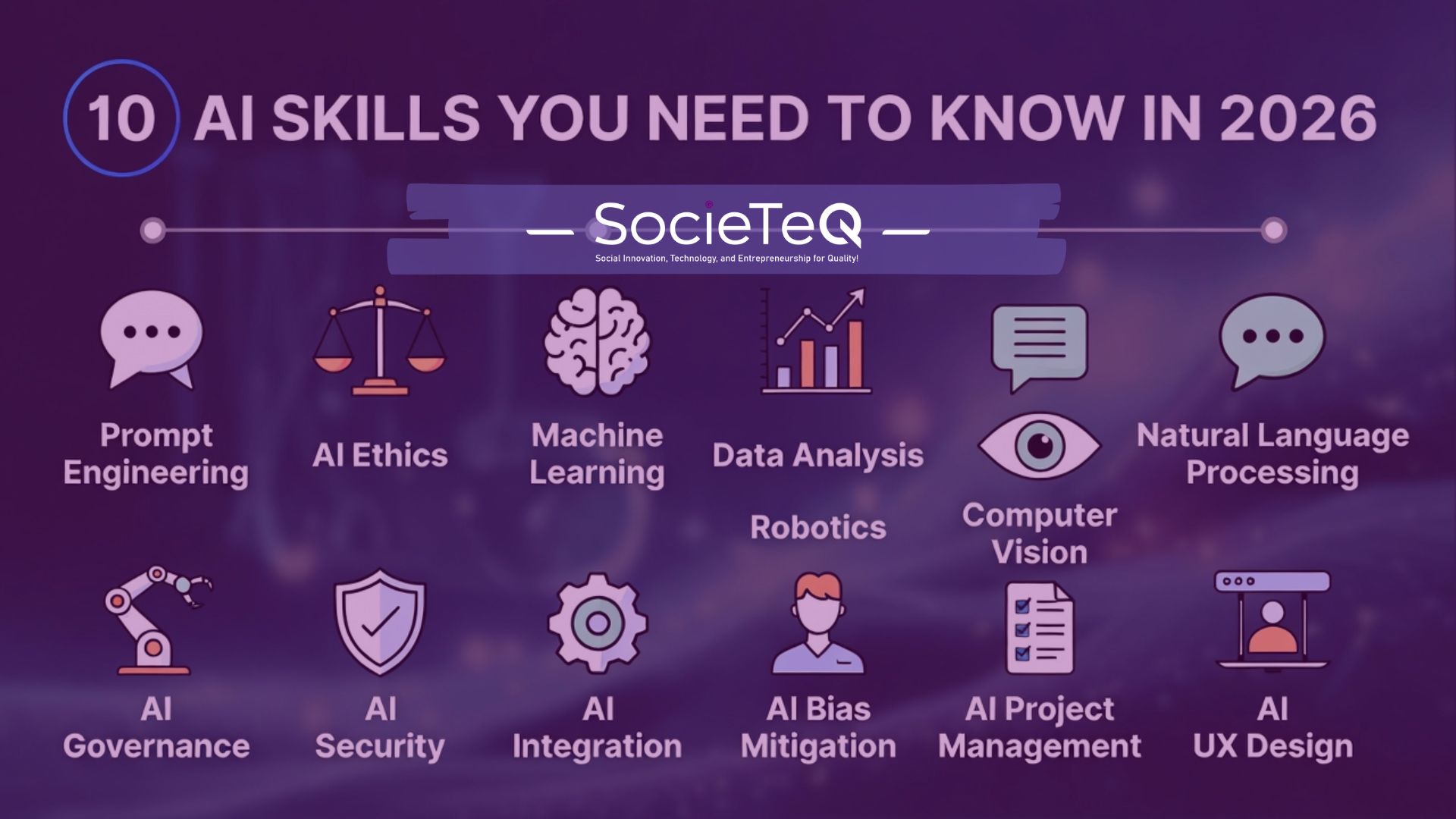
Artificial Intelligence (AI) is transforming industries, workflows, and job functions. Mastering AI skills is no longer exclusive to developers. It is essential for professionals, entrepreneurs, and teams across sectors.
Below are the 10 most important AI skills you should acquire by 2026, explained clearly with real-world relevance. 10 πιο σημαντικές δεξιότητες AI που θα είναι απαραίτητες στο 2026, μαζί με επεξηγήσεις και παραδείγματα χρήσης.
1. Prompt Engineering
Definition: Definition: The skill of crafting clear, effective prompts to get precise, useful outputs from large language models (LLMs).
Importance: Τα καλύτερα αποτελέσματα από συστήματα όπως ChatGPT ή Claude προέρχονται από καλά δομημένες προτροπές.
Source: Better prompts result in higher quality and more actionable responses from tools like ChatGPT.
Source: Prompt Engineering – Wikipedia (https://en.wikipedia.org/wiki/Prompt_engineering
) (https://en.wikipedia.org/wiki/Prompt_engineering)
2. Retrieval-Augmented Generation (RAG)
Definition: Technique combining external data retrieval with model-based generation for accuracy.
Benefit: Ensures answers are grounded in real sources, reducing errors.
Source: Retrieval-Augmented Generation – Wikipedia (https://en.wikipedia.org/wiki/Retrieval-augmented_generation)
3. AI Agents
Definition: Autonomous systems that perform tasks independently, such as scheduling, CRM updates, or reporting.
Use Case: Replace repetitive manual workflows.
Source: AI Agent – Wikipedia (https://en.wikipedia.org/wiki/AI_agent)
4. AI Literacy
Definition: Understanding what AI can and cannot do, including biases, limitations, and practical use.
Why It Matters: Informs responsible and effective AI application.
Source: AI Literacy – Wikipedia (https://en.wikipedia.org/wiki/AI_literacy)
5. Multimodal AI
Definition: AI systems capable of processing multiple types of data—text, images, audio, and video.
Application: Used in content creation, analysis, and cross-media workflows. Από δημιουργία περιεχομένου μέχρι ανάλυση δεδομένων σε πολλαπλά μέσα.
6. Workflow Automation
Definition: Definition: Implementing automated workflows for business processes such as onboarding, reporting, and CRM
Οφέλη: Benefits: Increases efficiency, consistency, and scalability.
7. AI Tool Stacking
Definition: Combining multiple AI tools to create seamless workflows with greater capabilities.
Example: Integrating Notion, Zapier, and LLMs to automate entire processes.
8. AI Content Systems Beyond Generation
Definition: Scaling content creation, distribution, and repurposing through AI systems—not just generating text.
Benefit: Generate quality content at scale without proportional increases in headcount.
9. LLM Management & AI Operations (AI Ops)
Definition: Managing LLM deployments, monitoring performance, and optimizing reliability.
Why It Matters: Ensures secure, efficient, and responsible use in production environments.
10. AI Ethics & Governance
Definition: Understanding ethical, legal, and compliance implications of AI systems.
Why It Matters: Critical for corporate responsibility and public trust.
Conclusion
These AI skills extend beyond technical expertise. They encompass strategic thinking, ethical awareness,, και and practical workflow integration.Whether you are a business leader, developer, or creative professional, mastering these skills will give you a competitive edge by 2026.